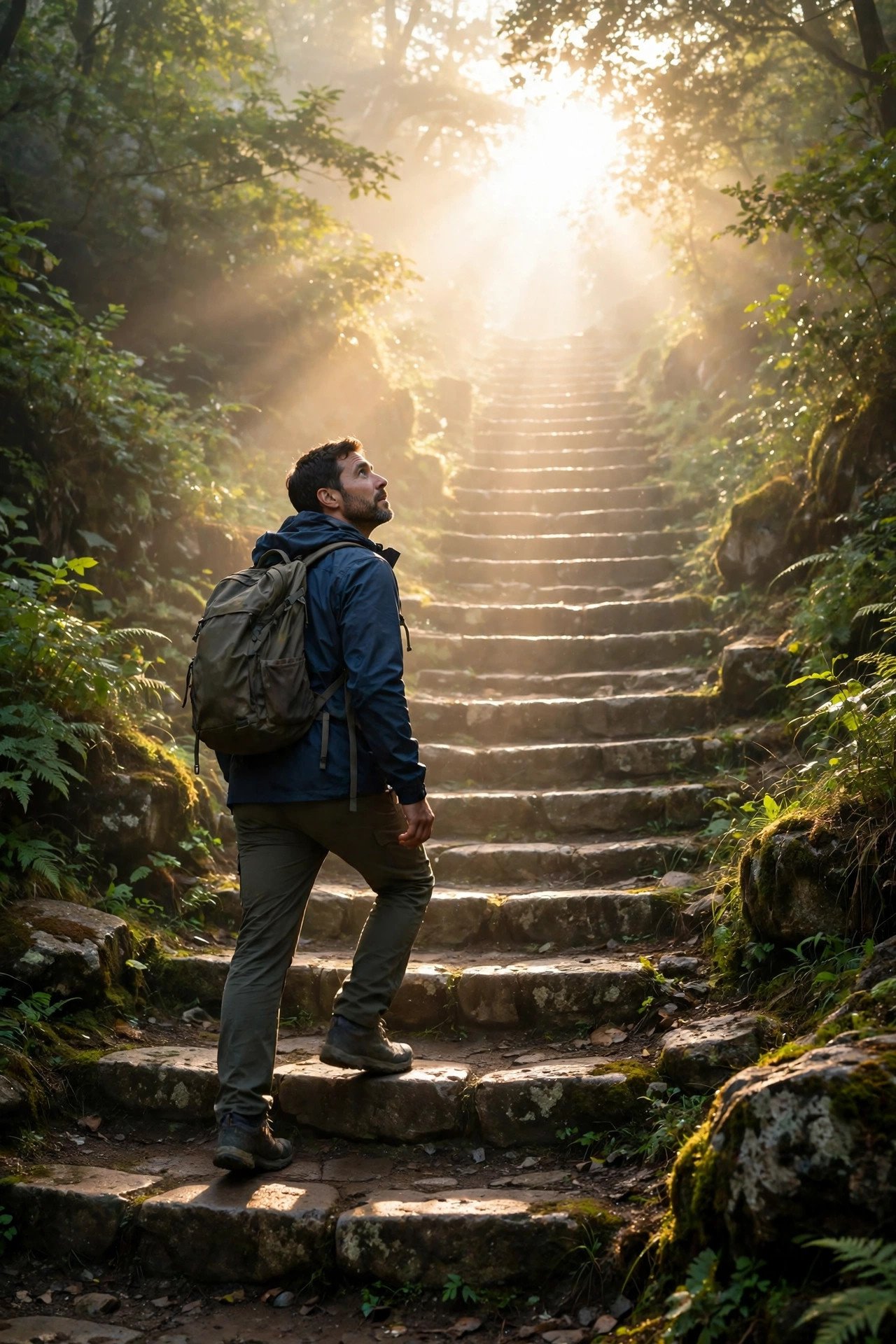
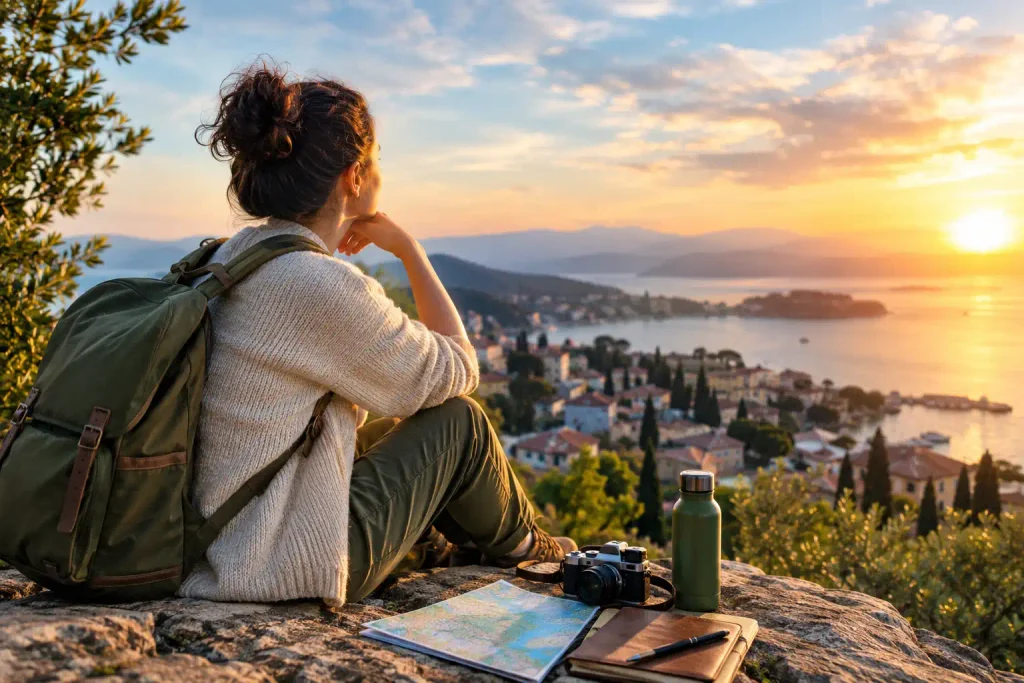

Let us make the World Tourism Day 2026 an opportunity to think about tourism from a different perspective. Have you ever thought about what happens to the mind when we travel?
The connection between mind and travel is not simply about escaping everyday life. Meaningful travel can expose us to different ways of living, encourage curiosity, create opportunities for reflection, and sometimes help us see familiar problems from a new angle.
And you don’t necessarily need an expensive international vacation to experience these benefits. Sometimes, changing your surroundings—even for a day—can change what you notice.
What Is World Tourism Day 2026?
World Tourism Day is observed annually on September 27 to highlight the social, cultural, economic, and broader importance of tourism.
For MindWiner, however, the day can be viewed through another lens: tourism as an experience that can influence human perspective.
Travel puts us in situations where our normal mental shortcuts do not always work.
At home, we know where things are, how people generally behave, what routines to follow, and what to expect. While traveling, many of those assumptions disappear.
That creates opportunities to observe, adapt, question, and learn.
In that sense, travel can become a practical exercise in mental flexibility.
How Does Travel Change the Way We Think?
Travel doesn’t automatically make someone wiser, happier, or more open-minded. A vacation can be relaxing without being particularly transformative.
The difference often lies in how we travel and what we pay attention to.
Several aspects of travel can influence our thinking.
1. New environments interrupt familiar thinking
Much of daily life runs on habit.
You wake up in a familiar room, follow familiar routes, interact with familiar people, and solve familiar problems. Because the environment is predictable, much of your attention operates automatically.
Travel interrupts that pattern.
Suddenly, you may need to understand a new transportation system, navigate unfamiliar streets, interpret unfamiliar social customs, or decide what to do without your usual routine.
These small disruptions can encourage greater awareness of the present moment.
Instead of moving through the day automatically, you may find yourself asking:
Where am I? What is happening? What should I do next?
That shift in attention can make an ordinary experience feel surprisingly vivid.
2. Different cultures challenge assumptions
One of travel’s most valuable mental experiences is discovering that your way of doing something isn’t necessarily the only way.
Different communities may have different approaches to:
- family life
- food
- work
- time
- hospitality
- communication
- celebrations
- education
- public spaces
- relationships
Encountering these differences doesn’t mean you must adopt every practice you see.
The value is in learning to distinguish between “different” and “wrong.”
That distinction can make thinking more flexible.
3. Travel can strengthen curiosity
Curiosity is one of the most useful mental habits a person can develop.
Instead of immediately judging something unfamiliar, curiosity asks:
“Why is it like this?”
That small change matters.
Imagine visiting a community where people eat at times that differ from your routine. You could simply think, That’s strange.
Or you could ask:
Why do people eat at this time? Is there a historical reason? Does the climate influence it? Is there a social tradition behind it?
The second response turns an unfamiliar experience into an opportunity to learn.
Travel provides thousands of these small opportunities.
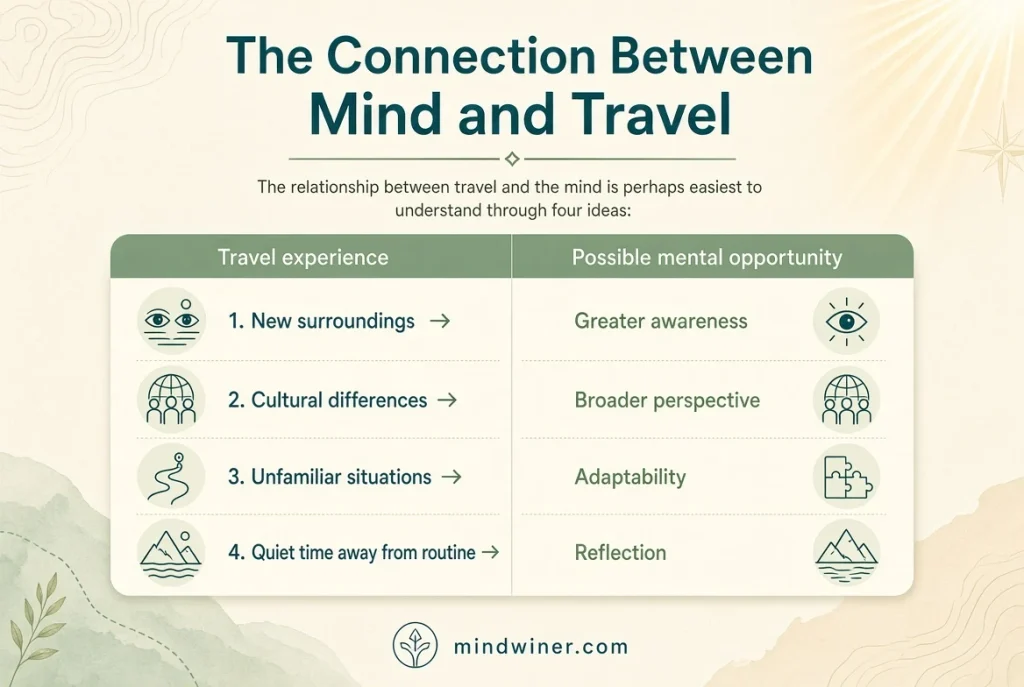
The Connection Between Mind and Travel
The relationship between travel and the mind is perhaps easiest to understand through four ideas:
| Travel experience | Possible mental opportunity |
| New surroundings | Greater awareness |
| Cultural differences | Broader perspective |
| Unfamiliar situations | Adaptability |
| Quiet time away from routine | Reflection |
These aren’t guaranteed psychological outcomes. People respond differently to travel, and stressful or poorly planned trips can have the opposite effect.
But when travel is approached intentionally, unfamiliar experiences can become useful material for personal reflection.
Can Travel Improve Self-Awareness?
It can create opportunities for self-awareness because travel removes some of the familiar structures that normally surround us.
At home, your identity may be reinforced by your usual roles:
employee, parent, student, friend, spouse, manager, neighbor.
When you’re somewhere unfamiliar, some of those roles become less visible.
You may discover things about yourself that routine has hidden.
For example:
- How do you react when plans suddenly change?
- Are you comfortable asking strangers for help?
- Do you become impatient when you don’t understand something?
- How do you respond when you make a mistake?
- Do you prefer control or flexibility?
- What do you actually miss when you’re away from home?
These questions can reveal patterns that are difficult to notice during ordinary routines.
A simple travel reflection exercise
At the end of a travel day, write down three answers:
- What surprised me today?
- Were my assumptions challenged?
- Did I learn about myself?
You don’t need a lengthy journal.
A few honest sentences can be enough.
Why Getting Outside Your Comfort Zone Matters
Personal growth often requires encountering situations that are unfamiliar without becoming overwhelmed by them.
Travel naturally creates such situations.
You might:
- order food in an unfamiliar setting
- navigate a city you’ve never visited
- communicate despite a language barrier
- try an unfamiliar activity
- ask someone for directions
- travel alone for the first time
- change plans when circumstances require it
These experiences can teach an important lesson:
Discomfort does not always mean danger or failure. Sometimes it simply means unfamiliarity.
That is a useful distinction far beyond travel.
The same mindset can help when starting a new job, speaking in public, learning a skill, meeting new people, or dealing with unexpected changes.
Travel Can Teach Adaptability
Few trips go exactly according to plan.
A delayed train, changed weather, closed attraction, missed connection, or unexpected change of schedule can turn a carefully designed itinerary into a problem-solving exercise.
The healthy response isn’t necessarily to remain calm every second.
It’s to ask:
“What can I do now?”
That question shifts attention away from what has already happened and toward the next available action.
This is a practical form of resilience.
A useful travel mindset
Instead of:
“This ruined my trip.”
Try:
“The original plan isn’t possible anymore. What’s the best option from here?”
The same mental shift can be useful when dealing with everyday setbacks.
A failed application, disappointing result, cancelled plan, or difficult conversation may not be fixable immediately.
But asking “What is my next useful action?” can prevent a setback from becoming a complete mental dead end.
Mindful Travel: Experiencing Instead of Just Recording
Modern travel can sometimes become an exercise in documentation.
Take the photograph.
Record the video.
Post the story.
Check the reactions.
Repeat.
There is nothing inherently wrong with taking photographs or sharing experiences. But constant documentation can sometimes pull attention away from the experience itself.
Mindful travel takes a different approach.
For a few minutes, put the phone away and notice:
- the sounds around you
- the architecture
- people’s movements
- local smells
- weather and temperature
- your own emotional response
- details you might normally overlook
Ask yourself:
“What would I notice if I didn’t need to photograph this?”
That question can transform a familiar tourist activity into a more attentive experience.
You Don’t Have to Travel Far to Expand Your Mind
One misconception about travel and personal growth is that meaningful transformation requires an international trip.
It doesn’t.
You could explore:
- a nearby town
- a museum you’ve never visited
- a different neighborhood
- a historical site
- a local cultural event
- a nature trail
- a community with traditions different from your own
The important ingredient isn’t necessarily distance.
It’s novelty combined with attention.
A person can travel thousands of miles and remain mentally closed to everything unfamiliar.
Another person can travel thirty miles and return home having discovered an entirely different perspective.
Travel, Perspective, and Everyday Problems
Distance from a familiar environment can sometimes change how a problem feels.
Consider someone who has spent weeks worrying about a disagreement at work.
During an ordinary day, the problem may occupy almost every spare moment.
Then they spend a weekend somewhere unfamiliar.
The problem hasn’t disappeared.
But surrounded by different people, landscapes, routines, and conversations, they may suddenly recognize that the situation has several possible interpretations.
Travel hasn’t solved the workplace conflict.
It has created mental distance from it.
That distinction matters.
Travel shouldn’t be treated as a cure for serious emotional or psychological problems. Persistent anxiety, depression, trauma-related symptoms, or other significant difficulties may require support from a qualified mental-health professional.
But stepping away from routine can sometimes create useful space for reflection.
A 5-Step Mindful Travel Experiment
If you want to use travel as a way to strengthen your perspective, try this simple approach.
Step 1: Leave some space in your schedule
Don’t fill every hour.
Allow time to wander, observe, sit quietly, or simply experience the surroundings.
Step 2: Notice something unfamiliar
Choose one thing you don’t immediately understand.
Instead of judging it, become curious about it.
Step 3: Have one genuine conversation
Speak with someone outside your normal social circle when appropriate and respectful.
Listen more than you speak.
Step 4: Notice your own reactions
When something goes wrong, observe your first response.
Do you become frustrated, anxious, controlling, impatient, or adaptable?
Don’t judge yourself. Simply notice.
Step 5: Bring one lesson home
Ask:
“What did this trip teach me that I can use in ordinary life?”
Perhaps it’s patience.
It may be the flexibility.
Probably it’s the realization that you’ve been making assumptions about other people.
You might have discovered that you need more quiet time.
The value of travel often becomes clearer after returning home
How to Make Your Next Trip More Mind-Expanding
Before your next trip, try setting a mental goal alongside your sightseeing goals.
Instead of only asking:
“What do I want to see?”
also ask:
“What do I want to notice?”
You might choose one of these intentions:
- understand a different culture
- practice patience
- become more comfortable with uncertainty
- spend less time on your phone
- have deeper conversations
- observe your reactions to unfamiliar situations
- learn something about local history
- spend time alone without constant entertainment
- challenge one assumption you hold
This turns travel into more than a checklist of attractions.
It becomes an opportunity to observe both the world outside you and the mind inside you.
World Tourism Day 2026: A Different Way to Think About Travel
World Tourism Day can be more than a celebration of destinations.
It can also be a reminder that human beings learn through encounters—with places, cultures, people, ideas, and experiences different from their own.
The most valuable souvenir from a journey may not fit inside a suitcase.
It might be a new question.
A corrected assumption.
A greater appreciation for another culture.
A better understanding of yourself.
Or simply the realization that there are many ways to live, think, solve problems, and see the world.
That is where the connection between mind and travel becomes especially meaningful for personal growth.
A simple question to carry with you
The next time you visit somewhere unfamiliar, don’t ask only:
“What can I see here?”
Ask:
“What can this place teach me about the world—and about myself?”
That question can turn sightseeing into reflection and movement into learning.
Conclusion
World Tourism Day 2026 offers an opportunity to look beyond tourism as transportation, accommodation, and sightseeing.
Travel can place us in unfamiliar situations, introduce us to different perspectives, interrupt automatic routines, and give us opportunities to observe our own reactions. None of these experiences guarantees personal transformation, but they can provide valuable material for curiosity, self-awareness, adaptability, and reflection.
And meaningful travel doesn’t always require a passport.
Sometimes, strengthening the mind begins by becoming genuinely curious about a place, person, culture, or idea that exists just outside our familiar world.
A journey changes more than the place you wake up in; sometimes, it changes what you notice when you finally return home.
FAQ Section
What is World Tourism Day 2026?
World Tourism Day 2026 is observed on September 27, 2026. The annual observance highlights tourism’s importance and provides an opportunity to consider how travel connects people, cultures, communities, and experiences.
How can travel change the way we think?
Travel exposes people to unfamiliar environments, cultures, routines, and situations. These experiences can encourage curiosity, adaptability, reflection, and awareness of assumptions. The effect differs from person to person and depends partly on how intentionally the experience is approached.
What is the connection between mind and travel?
The connection between mind and travel involves the way unfamiliar experiences can influence attention, perspective, curiosity, self-awareness, and adaptability. Travel doesn’t automatically change someone’s mindset, but it can create situations that encourage people to reconsider assumptions and reflect on their experiences.
Can travel improve mental wellbeing?
Travel may contribute to wellbeing for some people by providing enjoyable experiences, social connection, novelty, rest, or a break from routine. However, it isn’t a substitute for professional mental-health care, particularly when someone is experiencing persistent or serious psychological difficulties.
Does traveling make people more open-minded?
Travel can expose people to different cultural practices and perspectives, which may create opportunities to question assumptions. However, simply visiting another place does not guarantee greater open-mindedness. Curiosity, respectful interaction, and willingness to reflect are important parts of the experience.
What is mindful travel?
Mindful travel means paying deliberate attention to the experience rather than moving through a destination automatically. It can involve observing your surroundings, limiting unnecessary phone use, listening carefully to people, noticing your emotional reactions, and reflecting on what you are learning.
Can a short trip really contribute to personal growth?
Yes, a short trip can provide meaningful experiences, particularly when it involves something unfamiliar. Personal growth does not depend entirely on distance or duration. A nearby cultural event, museum, town, or nature visit can also create opportunities for curiosity and reflection.
How can travel build resilience?
Travel can involve uncertainty, changes of plan, navigation challenges, communication difficulties, and unfamiliar environments. Handling these situations can provide opportunities to practice flexibility and problem-solving. It should not be viewed as a guaranteed method for developing resilience.
PAA Questions Covered
- What is World Tourism Day 2026?
- How can travel change the way we think?
- What is the connection between mind and travel?
- Can travel improve mental wellbeing?
- Does traveling make people more open-minded?
- What is mindful travel?
- Can travel improve self-awareness?
- Can short trips contribute to personal growth?
- How can travel build resilience?
- Why does traveling outside your comfort zone matter?
- How can travel change your perspective?
- Do you have to travel abroad to experience personal growth?