


Mental strength is often misunderstood as being tough enough to handle everything without complaining, crying, asking for help, or showing uncertainty. That picture is incomplete.
A mentally strong person can feel disappointed, afraid, angry, stressed, or discouraged. The difference is often in what happens next. Instead of allowing a difficult emotion or setback to completely determine their behavior, they learn to acknowledge what they are experiencing, separate what they can control from what they cannot, and choose a constructive response.
Psychological resilience is not simply about “bouncing back” through willpower. The American Psychological Association describes resilience as successfully adapting to difficult experiences through mental, emotional, and behavioral flexibility. It also notes that resilience involves resources and skills that can be cultivated and practiced.
That makes mental strength less mysterious than it may appear.
It is not a personality badge that some people receive at birth. Many of its behaviors can be practiced.
Here are 12 habits commonly associated with a stronger, more resilient way of dealing with life.
What Does It Mean to Be Mentally Strong?
A mentally strong person is not someone who never struggles. Mental strength is better understood as the ability to respond to challenges with awareness, flexibility, self-control, and persistence while recognizing when support is needed.
A mentally strong person may still:
- feel nervous before an important decision
- become upset after criticism
- experience failure
- need time to recover from disappointment
- change their mind when circumstances change
- ask other people for help
- take a break when overwhelmed
The important part is that difficult emotions do not automatically dictate every decision.
Mental strength also should not be confused with emotional suppression. Ignoring sadness, anger, or fear does not necessarily make someone stronger. Healthy emotional functioning involves recognizing emotions and finding constructive ways to respond to them.
1. Focus on What They Can Control
One of the most useful habits of a mentally strong person is distinguishing between what is controllable and what is not.
You cannot control another person’s opinion, a past mistake, an unexpected delay, or every outcome of a difficult situation.
You can often control:
- how you prepare
- what you say next
- how you spend your time
- whether you ask for help
- whether you learn from the experience
- what action you take today
This distinction prevents a difficult situation from consuming unnecessary mental energy.
Try this
When something is bothering you, divide a page into two columns:
Within my control
Outside my control
Then choose one useful action from the first column.
For example, if you are worried about an interview, you cannot control the interviewer’s final decision. You can control your preparation, punctuality, answers, and follow-up.
That shift does not guarantee success. It simply puts your attention where it can be useful.
2. Allow Emotions Without Letting Emotions Drive Every Decision
Mental strength does not mean remaining calm every second.
A strong person can acknowledge:
“yes, I’m angry.”
“for now, I’m disappointed.”
“I’m afraid this may not work.”
The goal is not to eliminate the emotion. The goal is to create enough space between the emotion and the response to make a deliberate choice.
For example, receiving harsh criticism at work may trigger an immediate defensive response. A more constructive approach might be to pause, identify what specifically felt unfair, and decide whether there is useful information hidden inside the criticism.
This is emotional regulation in practice: recognize → pause → evaluate → respond.
The CDC similarly recommends approaches such as identifying and challenging unhelpful thoughts, journaling, relaxation techniques, healthy physical activity, and seeking support when coping becomes difficult.
Accept Reality Before Trying to Change It
Acceptance does not mean approval.
A mentally strong person can recognize that something unpleasant has happened without spending endless energy wishing that reality were different.
Consider losing an opportunity you wanted.
You can spend weeks thinking:
“This should not have happened.”
Or you can eventually ask:
“This happened. What can I learn from it, and what can I do now?”
The second question does not make the disappointment disappear. It changes your relationship with it.
Acceptance creates a starting point for problem-solving.
They Learn From Failure Instead of Turning Failure Into Identity
A setback can produce two very different conclusions.
“I failed at this.”
and
“I am a failure.”
The first describes an event. The second turns an event into an identity.
Mentally strong people tend to examine setbacks more constructively:
- What actually went wrong?
- What was within my control?
- What did I overlook?
- What should I repeat?
- What should I change next time?
The CDC recommends focusing on potential solutions, considering different perspectives, and learning from mistakes as part of working through challenges.
Failure becomes information rather than a permanent verdict about your worth.
Practice Self-Discipline When Motivation Is Unreliable
Motivation changes.
Some mornings you feel enthusiastic about exercising, studying, writing, or completing an important project. Other mornings you would rather avoid the task.
A mentally strong person does not necessarily feel motivated all the time. They develop systems that make useful behavior easier to repeat.
For example:
Instead of:
“I’ll study when I feel motivated.”
Try:
“I’ll study for 30 minutes after dinner.”
The second approach removes part of the daily negotiation.
Self-discipline does not mean forcing yourself relentlessly. It means creating reasonable commitments and following through consistently.
Challenge Unhelpful Thinking
Your first interpretation of an event is not always the most accurate interpretation.
Suppose your manager sends you a short message:
“We need to discuss your report tomorrow.”
You might immediately think:
“I’m in trouble.”
But there are many possible explanations.
probably the manager wants clarification. Perhaps there is a correction to make. May be they want to discuss another project.
Mentally strong thinking does not mean automatically replacing every negative thought with a positive one.
It means asking:
“What evidence do I actually have?”
Then:
“Is there another reasonable interpretation?”
This kind of cognitive flexibility can prevent assumptions from becoming unnecessary emotional distress. APA resources on resilience also emphasize flexibility in responding to challenging circumstances.
Set Healthy Boundaries
Mental strength includes knowing that you cannot be available to everyone all the time.
Healthy boundaries may involve saying:
- “I can’t take this on right now.”
- “I need some time before I respond.”
- “I’m not comfortable discussing that.”
- “I can help for an hour, but I can’t handle the entire task.”
Boundaries are not necessarily rejection. They are a way of communicating limits clearly.
This becomes especially important when constant demands from work, family, friends, or social media begin consuming attention that you need for your own responsibilities and well-being.
A strong mind is not built only by adding more responsibilities. Sometimes it becomes stronger by removing unnecessary ones.
Maintain Supportive Relationships
One of the biggest misconceptions about mental strength is that strong people handle everything alone.
Resilience does not require isolation.
The APA identifies social resources as one of the factors that contribute to resilience, while the CDC notes that supportive social connections can help people cope with stressful life challenges and support emotional well-being.
A mentally strong person knows whom they can talk to.
That may be:
- a trusted friend
- a family member
- a mentor
- a colleague
- a community member
- a qualified mental-health professional when appropriate
Asking for support is not evidence that you are weak. Sometimes it is a practical response to a problem that should not be handled alone.
Protect Physical Foundations
Mental strength is not completely separate from physical well-being.
Sleep, movement, nutrition, and recovery affect how well people function day to day. The CDC notes that adequate, quality sleep supports mood, stress management, attention, and memory.
This does not mean that every difficult emotional experience can be solved by exercising or sleeping more.
It means that basic physical care provides an important foundation.
A simple routine might include:
- maintaining a reasonably consistent sleep schedule
- moving your body regularly
- taking breaks during long periods of work
- eating regular, balanced meals
- spending some time outdoors
- reducing unnecessary late-night screen use
Mental strength is difficult to practice when your basic recovery needs are constantly neglected.
Adapt Instead of Clinging to One Plan
Life rarely follows a perfectly predictable plan.
A career opportunity may disappear. A relationship may change. A business idea may fail. A family responsibility may suddenly alter your priorities.
Mental rigidity says:
“This was supposed to happen exactly this way.”
Mental flexibility asks:
“Given what has changed, what makes sense now?”
Resilience involves adaptation, not stubbornly repeating the same strategy.
Sometimes persistence means continuing.
Sometimes persistence means changing the method.
And sometimes it means accepting that a particular goal no longer fits your circumstances.
The ability to distinguish between these situations is more useful than simply telling yourself to “never give up.”
Make Time for Reflection
Mentally strong people do not simply move from one experience to the next without examining what happened.
Reflection creates an opportunity to learn.
At the end of a difficult day, ask:
- What happened?
- What did I feel?
- What did I do well?
- Where did I react instead of respond?
- What is one thing I can do differently tomorrow?
Journaling can be one practical way to process emotions and examine difficult situations. The CDC includes journaling among healthy approaches to coping with stress.
The purpose is not to analyze yourself endlessly.
It is to turn experience into information.
Keep Going Without Pretending Everything Is Fine
Perhaps the most important habit is realistic persistence.
A mentally strong person does not need to convince themselves that every setback is secretly wonderful.
For sometimes failure simply hurts.
Sometimes uncertainty is genuinely frightening.
A difficult period often takes longer than expected.
Strength can look like saying:
“This is difficult, and I still need to take the next useful step.”
That is different from toxic positivity.
Grounded optimism does not require believing that everything will work out exactly as planned. APA materials distinguish realistic optimism from the unrealistic expectation that life will always go smoothly.
Hope becomes more useful when it is connected to action.
A Simple Daily Routine for Building Mental Strength
You do not need to transform your personality overnight.
Start with a small routine.
Morning: Choose Your Focus
Ask:
What is one thing that deserves my attention today?
Choose a controllable action rather than a vague goal.
Instead of:
“Have a productive day.”
Try:
“Finish the first section of my report before noon.”
During the Day: Pause Before Reacting
When something triggers frustration, use:
Pause → Breathe → Identify → Choose
Ask:
- What am I feeling?
- What triggered it?
- What is actually happening?
- What response would help?
Evening: Review the Day
Spend five minutes asking:
- What challenged me today?
- How did I respond?
- What did I learn?
- What can I improve tomorrow?
This is enough to begin turning ordinary experiences into opportunities for self-awareness.
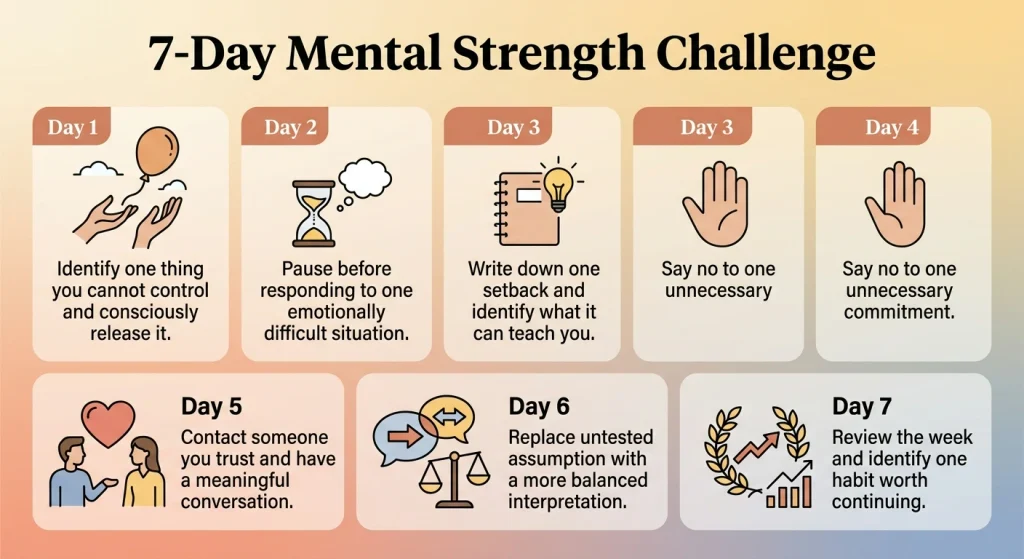
A 7-Day Mental Strength Challenge
If you want to put these ideas into practice, try this simple experiment.
| Day | Practice |
| Day 1 | Identify one thing you cannot control and consciously release it |
| Day 2 | Pause before responding to one emotionally difficult situation |
| Day 3 | Write down one setback and identify what it can teach you |
| Day 4 | Say no to one unnecessary commitment |
| Day 5 | Contact someone you trust and have a meaningful conversation |
| Day 6 | Replace one untested assumption with a more balanced interpretation |
| Day 7 | Review the week and identify one habit worth continuing |
The goal is not to become “mentally strong” in seven days.
The goal is to begin practicing behaviors associated with greater psychological flexibility and resilience.
What Mentally Strong People Do Not Do
Mental strength is easier to understand when we remove some common misconceptions.
A mentally strong person does not necessarily:
- hide every emotion
- solve every problem alone
- remain positive all the time
- tolerate disrespect
- avoid asking for help
- work constantly
- never make mistakes
- control every outcome
- pretend that painful experiences do not hurt
Strength is not emotional numbness.
It is the ability to experience reality without allowing every difficult moment to dictate your entire direction.
Mental Strength vs. Emotional Suppression
| Mental Strength | Emotional Suppression |
| Recognizes difficult emotions | Pretends difficult emotions do not exist |
| Responds deliberately | Reacts later or avoids the issue |
| Accepts reality | Denies uncomfortable reality |
| Asks for help when necessary | Believes asking for help is weakness |
| Learns from mistakes | Hides or refuses to examine mistakes |
| Adapts to circumstances | Rigidly resists change |
| Uses emotions as information | Treats emotions as something that must always be eliminated |
This distinction matters because someone can look extremely composed while struggling internally.
Being quiet, unemotional, or highly independent is not automatically evidence of psychological strength.
Conclusion
Start smaller than your ambition suggests.
Choose one habit from this article and practice it consistently for the next two weeks.
For example, if you tend to overthink situations you cannot control, practice the control exercise each evening.
If criticism affects you strongly, practice separating the useful information from the emotional reaction.
If you frequently abandon goals when motivation disappears, establish one small daily commitment and keep it manageable.
Mental strength grows through repeated responses to ordinary situations.
You do not have to wait for a major crisis to practice.
Every frustrating email, difficult conversation, disappointing result, uncertain decision, and uncomfortable emotion provides an opportunity to practice responding differently.
And if stress, anxiety, sadness, or other difficulties are persistent or interfering significantly with everyday life, self-help habits may not be enough. Speaking with a qualified mental-health professional can provide more appropriate support. The CDC likewise recommends seeking professional help when emotional difficulties become overwhelming or interfere with daily life.
Mental strength is not the absence of struggle. It is the practice of responding to struggle without losing yourself in it.
FAQ
What are the habits of a mentally strong person?
Common habits include focusing on controllable factors, regulating emotions rather than suppressing them, learning from failure, practicing self-discipline, maintaining healthy boundaries, seeking support, adapting to change, reflecting on experiences, and continuing to take constructive action during difficult periods.
Can mental strength be developed?
Yes. Resilience-related skills and resources can be cultivated and practiced. Mental strength is not simply a fixed personality characteristic. Small repeated behaviors—such as constructive problem-solving, emotional awareness, reflection, healthy coping, and maintaining supportive relationships—can contribute to greater resilience.
Does being mentally strong mean controlling your emotions?
No. Mental strength does not mean eliminating or hiding emotions. A healthier goal is to recognize emotions, understand what they may be communicating, and choose a deliberate response rather than allowing an immediate emotional reaction to determine your behavior.
What is the difference between mental strength and mental toughness?
The terms overlap, but mental strength is often broader. It can include emotional regulation, resilience, self-awareness, flexibility, healthy coping, self-discipline, and the ability to seek support. Mental strength does not require constant hardness or emotional suppression.
How do mentally strong people deal with failure?
They can treat failure as information rather than automatically turning it into a judgment about their identity. They examine what happened, identify what they can control, learn from mistakes, adjust their approach, and decide what useful step comes next.
Can journaling help build mental strength?
Journaling can be a useful reflection and coping practice for some people. Writing about emotions and difficult situations may help organize thoughts and identify patterns or possible solutions. It is a self-help tool rather than a replacement for professional care when serious or persistent difficulties require treatment.
Do mentally strong people ask for help?
Yes. Seeking appropriate support can be part of resilience rather than a sign of weakness. Supportive relationships can help people cope with stressful experiences, and social resources are recognized as an important component of resilience.
How can I become mentally stronger every day?
Start with one behavior you can repeat. For example, spend five minutes each evening identifying what was within your control, what challenged you, how you responded, and what you can learn. Gradually add practices such as healthy boundaries, reflection, constructive problem-solving, regular physical activity, adequate sleep, and meaningful social connection.
Is staying positive a sign of mental strength?
Not necessarily. Mental strength is better represented by realistic and flexible thinking than by forced positivity. A mentally strong person can acknowledge that something is painful or uncertain while still looking for constructive actions and possible paths forward.








Pingback: Deep Work: How to Focus for Hours Without Getting Distracted
Pingback: How to Stay Disciplined When Motivation Fades