
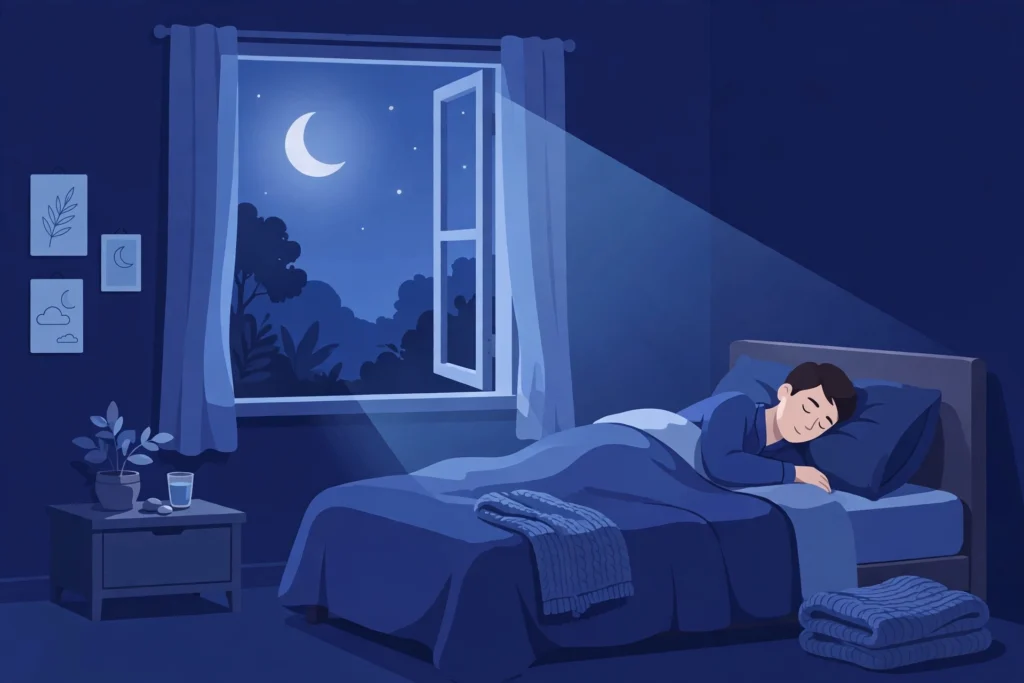

The house is quiet. The lights are off. Everyone else seems to be sleeping peacefully. If you’re lying awake with a racing mind, learning to calm anxiety at night can make all the difference.
But your mind has other plans.
The moment your head hits the pillow, the thoughts begin. That conversation from earlier. Tomorrow’s deadlines. The thing you said three years ago that suddenly feels embarrassing again. Your brain replays, rehearses, and worries — and sleep feels further away with every passing minute.
If this sounds familiar, you are not alone. Nighttime anxiety is one of the most common sleep complaints, and it makes sense: when the distractions of the day fade, there is nothing left to drown out the noise in your head.
The good news is that anxiety at night can be managed. Not with perfect calm or an empty mind, but with practical strategies that tell your nervous system it is safe to rest.
Here are nine of them.
Why Does Anxiety Get Worse at Night?
Understanding the problem makes it easier to solve.
During the day, your brain is occupied. Work, conversations, screens, and errands keep your attention moving outward. At night, all of that stimulation disappears, and your attention turns inward — right toward the worries you successfully avoided all day.
There are also physical reasons:
- Cortisol patterns: Stress hormones that helped you power through the day don’t always switch off on schedule.
- Fatigue lowers your defenses: A tired brain is worse at dismissing irrational worries. Thoughts that seem manageable at noon can feel catastrophic at midnight.
- Lack of new input: With nothing new to process, your brain defaults to replaying unresolved concerns.
This doesn’t mean something is wrong with you. It means your brain is doing its job a little too enthusiastically at the wrong hour.
1. Give Your Worries an Earlier Appointment
One of the most effective techniques for nighttime anxiety is surprisingly simple: schedule your worrying.
Set aside 15 minutes in the late afternoon or early evening — not right before bed — to write down everything on your mind. Upcoming tasks, unresolved conversations, vague fears. Get them out of your head and onto paper.
Then, when a worry appears at bedtime, you can tell yourself:
“I’ve already thought about this today. It’s on the list. I’ll deal with it tomorrow.”
This works because your brain replays worries partly out of fear of forgetting them. Writing them down removes that fear.
Keep a notepad by your bed too. If a genuinely new concern appears, jot it down in a few words and let it go. The note will be there in the morning.
2. Create a Wind-Down Routine (And Actually Follow It)
You probably wouldn’t sprint right up to a red light and slam the brakes. Yet many people work, scroll, or stress right up until the moment they expect to fall asleep.
In other words, your brain needs a transition.
Build a 30–60 minute wind-down routine that signals to your body that the day is ending. It doesn’t need to be elaborate:
- Dim the lights
- Take a warm shower
- Read something calm (not work emails)
- Stretch gently for five minutes
- Listen to quiet music or a sleep story
The power is in the repetition. After a week or two, your brain starts associating the routine with sleep, and drowsiness arrives more naturally. A consistent nightly routine is one of the most reliable ways to calm anxiety at night.
3. Try the 4-7-8 Breathing Technique to Calm Anxiety at Night
When anxiety spikes at night, your breathing often becomes shallow and fast — which tells your nervous system that something is wrong.
Deliberate slow breathing reverses that signal.
Try this:
- Breathe in quietly through your nose for 4 counts
- Hold your breath for 7 counts
- Exhale slowly through your mouth for 8 counts
- Repeat 3–4 cycles
Don’t worry about doing it perfectly. The extended exhale is the key — it activates your parasympathetic nervous system, the part responsible for rest and recovery.
If 4-7-8 feels too long at first, start with 4-4-6 and work your way up.
4. Stop Checking the Clock to Calm Anxiety at Night
Few things fuel nighttime anxiety like watching the hours pass.
“It’s 2 AM. I have to be up at 6. That’s only four hours. Now it’s 2:07…”
This mental math creates pressure, and pressure is the enemy of sleep. The more you monitor your remaining sleep time, the more anxious — and awake — you become.
Turn your clock face away. Put your phone face-down across the room. If you wake in the night, resist the urge to check the time.
You don’t need to know what time it is. You only need to rest.
5. Challenge the Nighttime Narratives
Anxiety at night loves to tell stories. Usually dramatic ones:
- “I’ll never fall asleep.”
- “Tomorrow is going to be a disaster.”
- “Something must be seriously wrong with me.”
In the dark, at 2 AM, these thoughts feel like facts. They’re not. They’re symptoms of a tired, anxious brain.
Practice noticing the story without buying into it:
- “I’m having the thought that I’ll never sleep” (instead of “I’ll never sleep”)
- “My brain is catastrophizing because I’m tired” (instead of “Tomorrow will be terrible”)
This small shift — observing the thought rather than living inside it — can take away much of its power.
6. Get Out of Bed If You’re Stuck
This advice sounds backwards, but it’s backed by sleep science.
If you’ve been lying awake for more than about 20 minutes, get up. Go to another room, keep the lights dim, and do something boring and calm — read a dull book, fold laundry, listen to quiet music.
Return to bed only when you feel sleepy.
Why? Because your brain forms associations. If you spend hours tossing and turning in bed, your brain starts associating your bed with frustration and wakefulness. Getting up breaks that association and rebuilds the connection between bed and sleep.
Your bed should mean sleep — not struggle.
7. Limit Caffeine and Screens Earlier Than You Think
You probably know caffeine affects sleep. But many people underestimate how long it lasts.
Caffeine has a half-life of about 5–6 hours, meaning half of that afternoon coffee is still in your system at bedtime. If anxiety already keeps you up, consider making noon your caffeine cutoff.
Screens deserve the same honesty. It’s not just the blue light — it’s the stimulation. News, arguments in comment sections, exciting shows, and endless scrolling all keep your brain in an alert, reactive state.
Try this rule: no news, no arguments, and no work after 9 PM. Your nervous system will thank you.
8. Use Progressive Muscle Relaxation to Calm Anxiety at Night
Anxiety lives in the body as much as in the mind. If your thoughts won’t quiet down, work through your muscles instead.
Starting from your toes and moving upward:
- Tense each muscle group for 5 seconds
- Release completely
- Notice the difference between tension and relaxation
- Move to the next group: calves, thighs, stomach, hands, arms, shoulders, face
By the time you reach your head, your body has received a clear physical message: we are safe, and we can let go.
Many people fall asleep before they finish the sequence.
9. Calm Anxiety at Night by Accepting Wakefulness Instead of Fighting It
In fact, this is the hardest — and often the most powerful — strategy.
Much of nighttime anxiety comes not from being awake, but from being upset about being awake. The frustration, the clock-watching, the fear of tomorrow’s exhaustion — that’s what truly keeps you wired.
Try a different stance:
“I’m resting right now, even if I’m not sleeping. That’s okay.”
Lying quietly in the dark with relaxed muscles is still restful. Removing the pressure to fall asleep often allows sleep to arrive on its own — precisely because you stopped chasing it.
When to Seek Extra Support
Occasional anxious nights are normal, especially during stressful periods. But consider speaking with a healthcare professional if:
- Sleeplessness happens most nights for several weeks
- Anxiety significantly affects your daily functioning
- You experience panic attacks at night
- You rely on alcohol or sleep aids to fall asleep regularly
- You feel hopeless about your sleep
Seeking help isn’t a sign of failure. It’s a sign you’re taking the problem seriously.
Final Thoughts: Be Patient With Your Nighttime Brain
Learning how to calm anxiety at night isn’t about achieving perfect, instant sleep. It’s about gradually teaching your nervous system that bedtime is safe.
Start with one or two strategies — perhaps the worry journal and the breathing technique — and give them a fair trial of a week or two. Small, consistent changes often outperform dramatic overhauls.
And remember: a difficult night doesn’t define you. Even poor sleepers have good nights. Your job isn’t to force sleep to come. Your job is to create the conditions where it can.
Tonight, try putting the worries on paper, breathing slowly, and turning the clock away. Your mind has been working hard all day. Each of these small habits helps you calm anxiety at night.
It deserves to rest.

Asad ullah Ijaz is a sociologist who writes about the mind — how society, norms and culture shape the way we think and feel. On MindWiner, he turns practical psychology into clear, reader-first guides for a stronger mind.






Pingback: Breathing Techniques for Anxiety: 7 Simple Exercises That Work