
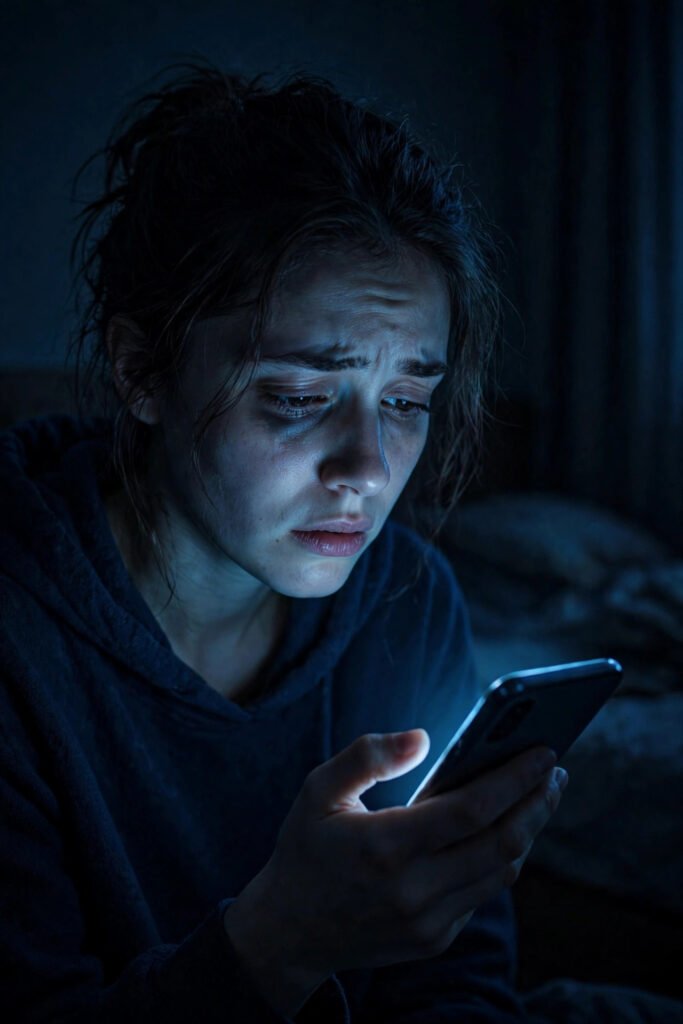

You pick up your phone for “just five minutes.” An hour later, your chest feels tight. Your mind is racing. Everyone online seems successful, beautiful, and happy — and you feel like you are falling behind.
Sound familiar? Then you have probably asked the question this article answers: does social media make anxiety worse? The short answer is yes — for many people, it does. But the longer answer is more useful. Below, you will learn exactly how your feed feeds your anxiety, the seven warning signs to watch for, and six practical ways to take back control.
Does Social Media Make Anxiety Worse? Here’s What the Research Shows
Researchers have studied this question for over a decade. Their findings point in one direction: heavy social media use is linked to higher anxiety, especially among teenagers and young adults. However, the platforms are not the whole story — *how* you use them matters more than *how much*.
The key finding is about passive scrolling. When you scroll without posting or interacting — just watching other people’s lives — anxiety rises. But when you use the apps actively, messaging friends or sharing your own life, the effect is much smaller. Therefore it is not the phone in your hand. It is the window-shopping through other people’s highlight reels.
Another finding matters too. The anxiety does not come from one big event. It builds slowly — one comparison, one missed message, one doom-scroll at midnight at a time. Because the buildup is gradual, most people never connect their tight chest to their screen time. That is exactly why the signs below matter so much.
7 Signs Your Feed Is Raising Your Anxiety
1. You feel worse after scrolling, not better. This is the biggest sign. If you open the app feeling fine and close it feeling empty, jealous, or restless — that is data. Your body is telling you the truth before your mind admits it.
2. You compare your life to strangers constantly. Their vacations, their bodies, their relationships. You know their posts are curated. Yet your nervous system reacts as if they are real-time reports. Because your brain evolved for small groups, it treats 500 online “friends” like 500 neighbors to compete with.
3. You feel pressure to respond instantly. The read receipts. The “last seen” timestamps. The double blue ticks. They create a low-grade panic: *Why hasn’t she replied? Did I say something wrong?* This is not real urgency. It is engineered urgency.
4. You doom-scroll before bed. Bad news, outrage, and crisis clips — one after another, long past midnight. Your brain cannot tell the difference between a threat on screen and a threat in the room. So it stays in fight-or-flight mode, and sleep suffers. Poor sleep then raises anxiety the next day. It is a vicious circle.
5. You feel anxious when you cannot check your phone. If leaving your phone in another room makes your hand twitch, that is not a habit anymore — it is dependence. The fear of missing out (FOMO) is anxiety wearing a modern costume.
6. Online conflict ruins your whole day. A harsh comment, a public disagreement, a screenshot shared without context. Because online arguments lack tone, faces, and resolution, they replay in your head for hours. One stranger’s words should not get that much power — but the design gives it to them.
7. You perform happiness instead of feeling it. You post the smiling photo while feeling miserable. You write the grateful caption while crying inside. This gap between your posted self and your real self is exhausting. And it teaches your brain a painful lesson: my real feelings are not acceptable.
If three or more of these sound like you, your feed is not neutral. It is an anxiety machine — and it is time to change the relationship.
*A gentle note: if your anxiety feels constant, overwhelming, or starts affecting your sleep, work, or relationships, please talk to a counselor or mental health professional. These strategies can help, but they are not a substitute for professional support.*
A Sociologist’s Take: The Feed as a Distorted Mirror of “Normal”
Here is the deeper question. Why does a stranger’s vacation photo make your stomach drop? The answer is not just psychology — it is sociology.
Humans learn what is “normal” by watching others. Sociologists call this social learning: you figure out how your life *should* look by observing the group around you. For most of history, that group was your village — a few dozen real people with ordinary lives.
Social media replaced your village with a stadium. Your “group” is now thousands of curated profiles, each showing only its best moments. Therefore your brain’s definition of normal has been quietly rewritten. Normal now means: always traveling, always glowing, always achieving, always happy. Anything less feels like failure — even though nobody actually lives like that.
There is another layer. The feed runs on norms of constant performance. You are not just watching — you are expected to perform too. Post regularly. Look happy. Show progress. This turns life into an endless audition, and auditions are stressful by design. When your worth feels like it depends on the next post’s performance, anxiety is the logical result — not a personal weakness.
The escape is not deleting every app. It is remembering what the feed really is: a distorted mirror, built to keep you watching, not to show you the truth.
6 Ways to Take Back Control From Your Feed
You do not need to quit social media forever. You need to change the terms of the relationship. Here is how:
1. Audit your feed like you audit your diet. Go through the accounts you follow. For each one, ask: “Do I feel better or worse after seeing their posts?” Mute anyone who consistently makes you feel small. Because your feed is an environment, curating it is self-care — not rudeness.
2. Turn off the anxiety triggers. Disable read receipts, “last seen,” and non-essential notifications. These features exist to keep you checking, not to keep you calm. When you remove them, the false urgency disappears — and your nervous system finally relaxes.
3. Set a scroll curfew. No social media for the first hour after waking and the last hour before sleep. Your brain is most vulnerable to comparison when it is tired. Protect those two hours, and your whole day feels steadier.
4. Replace passive scrolling with active use. If you are going to open the app, use it to connect — message a friend, comment with kindness, share something real. Active use builds relationships. Passive use builds anxiety. The same app can do either, depending on your hands.
5. Schedule phone-free blocks. Start small: one hour a day with the phone in another room. Notice what happens. At first, your hand will reach for it. Then the twitch fades. Soon you will remember what your own thoughts sound like without the background noise.
6. Follow reality, not just reels. Add accounts that show real life — the messy, the ordinary, the honest. Creators who talk about bad days, normal bodies, and quiet lives. Because your brain learns “normal” from what it sees, feeding it reality is the fastest way to heal the distortion.
Frequently Asked Questions
Does social media cause anxiety, or just make it worse?
For most people, it worsens existing anxiety rather than creating it from nothing. However, heavy passive use can create anxiety-like symptoms — restlessness, comparison, poor sleep — even in people who were previously fine. The relationship runs both ways: anxious people scroll more, and scrolling more raises anxiety.
Which social media platform is worst for anxiety?
It depends on how you use it, not which logo is on the app. Image-heavy platforms tend to trigger more appearance comparison, while news-heavy ones trigger more outrage and doom-scrolling. But any platform becomes harmful when used passively for hours. The behavior matters more than the brand.
How much social media is too much?
There is no magic number. The better test is the feeling test: do you feel worse after using it? Do you struggle to stop? Is it eating into sleep, work, or real relationships? If you answered yes to any of these, the amount is too much — regardless of the minutes.
Should I delete all my social media accounts?
Not necessarily. Total deletion works for some people, but most do better with boundaries — curfews, muted accounts, and notification limits. Try the six strategies above for two weeks first. If your anxiety is still high, then consider a full break. The goal is a calmer mind, not a perfect digital detox.
Can social media ever help with anxiety?
Yes. Supportive online communities, mental health educators, and staying in touch with far-away friends can genuinely help. The difference is intention: are you using the app to connect and learn, or to compare and escape? One heals. The other harms.
Final Thoughts: Your Feed Should Serve You, Not Stress You
Social media is a tool. A tool should work for you — not the other way around.
You do not need to fear your phone. You need to run it like a responsible owner: curate the feed, set the hours, and notice how you feel. The moment your scroll starts costing you your peace, you have every right to change the terms. Your calm is worth more than anyone’s highlight reel.

Asad ullah Ijaz is a sociologist who writes about the mind — how society, norms and culture shape the way we think and feel. On MindWiner, he turns practical psychology into clear, reader-first guides for a stronger mind.